
Introduction
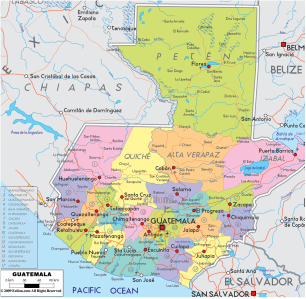 The region Quiché, where Menchú was born, is located in the Western Highlands of Central Guatemala; Source: Ezilon, 2009
Home to roughly 15.5 million people, Guatemala contains one the largest indigenous populations in Central America, with nearly 60% of its population indigenous; the remainder consists of ladinos [people of mixed European descent]. Historically, there were many class tensions between the ladinos and the indigenous remnant from Spanish conquest, thus leading to imminent conflict.
Guatemalan Civil War
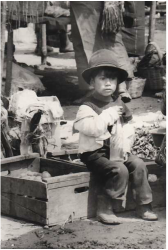 Guatemalan child lost in civil war; Source: Vagabond Journey (Long Island University) Guatemalan child lost in civil war; Source: Vagabond Journey (Long Island University)
Lasting from 1960 to 1996, the Guatemalan Civil War resulted in more than "150,000 deaths, 150,000 disappearances, 1.5 million refugees, 200,000 orphans, and 40,000 widows" (Dante Liano, The Rigoberta Menchú Tum Controversy). Conflict originated in 1954, when CIA-backed Castillo Armas become president by military coup. Under his rule, the military grew more forceful, and suppressed form of any protest. After his assassination, the government degraded into further coups and counter-coups, and military dictators reigned.
|
Source: When the Mountains Tremble, 1983
|
|
Source: When the Mountains Tremble, 1983
|
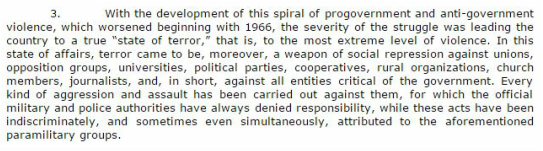
Report on the Situation of Human Rights in the Republic of Guatemala, 1981; Source: Organización de los Estados Americanos
|
This terroristic repression caused left-wing insurgents to rise up in response against the military, leading to a cycle of rebellion and government oppression.
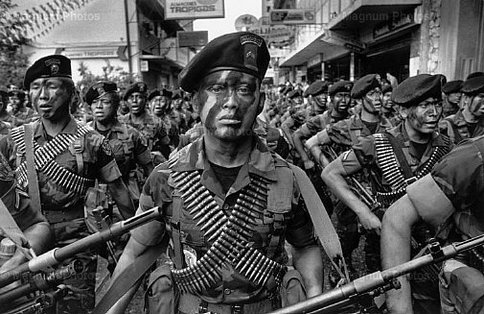
Kaibiles, a special counter-insurgency force of the Guatemalan Army;
Source: eLibrary, photographed by Larry Towell, 1988
|
"How could I tell them of watching a soldier bayonet my aunt in the stomach, rip out her four-month fetus, and smash it against a house post? How could I speak to them of our children waking up screaming in the middle of the night, beyond comforting, and of our nightly prayers to God for justice in our land? And how should we seek justice, by arming ourselves?" |
Silent Holocaust
"You must watch their eyes. No one will talk. You must try and see what they may be trying to tell you with their eyes...If you try to [go to the countryside]...the thing that will most move you is the silence. They will not talk to you because to talk would mean risking their very lives, and the people are already terrorized and prefer not to talk. What you'll really notice is that people will do one of two things. Either they will say that the army is very good, or they will not say anything. They are never going to tell you that it's the army that attacks them." |
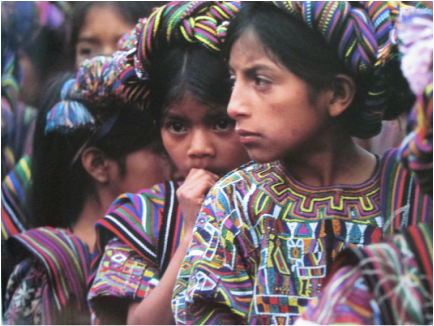
Ixil schoolgirls; Source: Guatemala: Eternal Spring, Eternal Tyranny, 1987
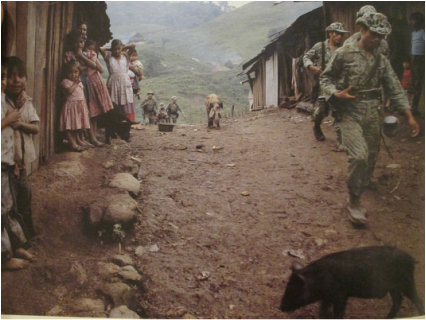
Army occupation, Ixcán, Quiché; Source: Guatemala: Eternal Spring, Eternal Tyranny, 1987
|
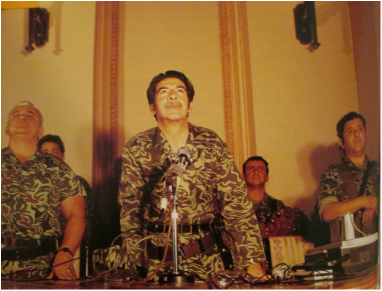 Brigadier General Efrain Rios Montt, flanked by General Horacio Egberto Maldonado Schaad (left) and Colonel Francisco Luis Gordillo Martínez (right); Source: Guatemala: Eternal Spring, Eternal Tyranny
The "Silent Holocaust" began with Ríos Montt in 1982. He targeted Mayan indigenous groups, convinced they were the source of the insurgency.
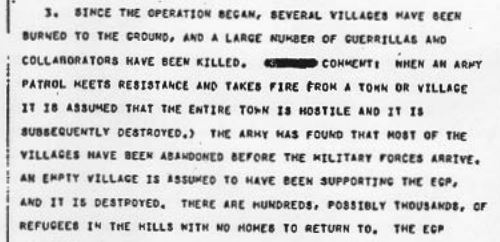
A secret CIA cable from February, 1982, at the height of the Guatemalan genocide; Source: National Security Archives
"In reality, the subversives need the support of the population. There is a principle of Mao Zedong, where he says that water is to the fish what the people are to the guerrilla. The fish, without water, dies! The guerrilla, without the people, dies."
-Colonel Francisco Gordillo Martínez, member of Montt's military triumvirate; When the Mountains Tremble
|
Ríos Montt and his administration subsequently mapped out the complete genocide of designated Mayan communities, while employing the usage of concentration ("model") camps. A later investigation by the United Nations CEH (Commission for Historical Clarification) documented 626 army massacres between 1981 and 1983. |
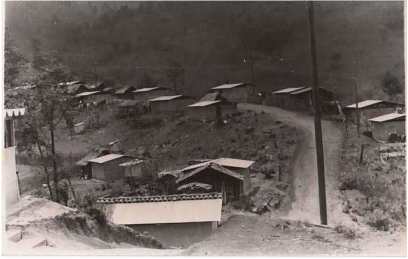
An internment camp during the Civil War; Source: Vagabond Journey (Long Island University)
|
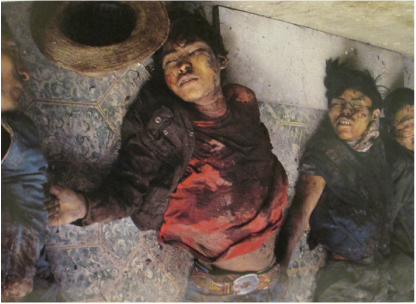
Dead suspected guerirllas, Nebaj, Quiché; Source: Guatemala: Eternal Spring, Eternal Tyranny
"[The CEH found] evidence of multiple ferocious acts preceding, accompanying, and following the killing of the victims. The assassination of children, often by beating them against the wall or by throwing them alive into graves to be later crushed by the bodies of dead adults...pouring gasoline on people and burning them alive...The military destroyed ceremonial sites, sacred places, and cultural symbols. Indigenous language and dress were repressed...Legitimate authority of the communities was destroyed."
-Greg Grandin, "It Was Heaven That They Burned"; qtd from Guatemala: Memory of Silence; Report of the Commission for Historical Clarification