
Childhood & Beyond
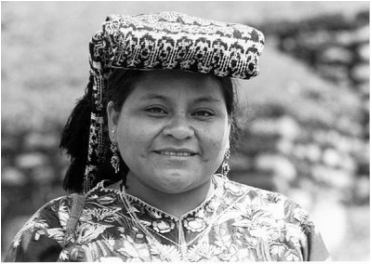
Source: Encontrarte
|
It was into this era of government repression that Rigoberta Menchú was born in 1959, in a remote village called Chimel. As one of nine children born to Vicente Menchú and Juana Tum Cotojá, she learned from a young age that her life would be difficult, but also filled with joy from her community and culture.
|
|
Menchú's family owned a small plot of land in the altiplanos [mountainous region], but was forced to work on the fincas [large plantations]. The conditions on the fincas were often hazardous; the underpaid laborers had polluted water, rotten food, lack of sufficient space, and were poisoned by sudden pesticide sprays.
|
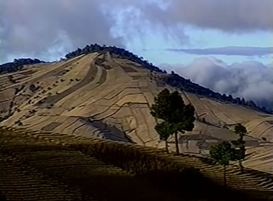
One of the altiplanos such as where Menchú grew up; Source: When the Mountains Tremble, 1983
|
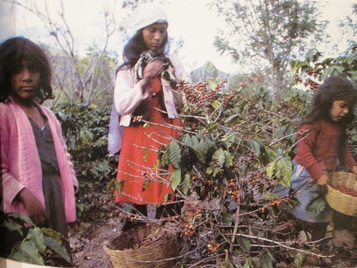
Children and teenager picking coffee, Jocotenango, Sacatepéquez; Source: Guatemala: Eternal Spring, Eternal Tyranny, 1987
"We'd been in the finca for fifteen days, when one of my brothers died from malnutrition...His name was Nicolás...He was two then. When my little brother started crying, crying, crying, my mother didn't know what to do with him because his belly was swollen by malnutrition...The time came when my mother couldn't spend any more time with him or they'd take her job away...He lasted fifteen days and went into his death throes, and we didn't know what to do...Who was there to turn to? There was no one we could count on... |
Source: When the Mountains Tremble, 1983
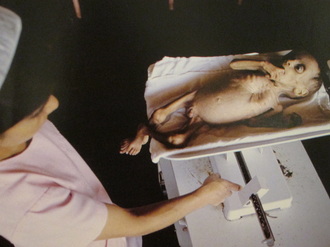
Nine-month boy at a clinic, Guatemala City. He died the following day; Source: Guatemala: Eternal Spring, Eternal Tragedy, 1987
"Chronic child malnutrition is at about 50%, the highest rate in Latin America, and the fourth-highest rate in the world." "Chronic undernutrition in indigenous areas is 69.5 percent. Fifty-three percent of the population lives in poverty, and 13 percent in extreme poverty." |
Death Comes to the Family
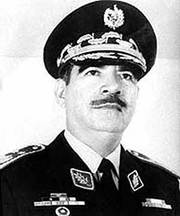 General Fernando Romeo Lucas García; Source: Elmundo.es General Fernando Romeo Lucas García; Source: Elmundo.es
In 1978, General Lucas García came into power, bringing more civil unrest and violence. At this time, the Menchú family began to involve itself more deeply with the Peasants’ Unity Committee (CUC) at Menchú’s father’s initiative. Consequently, Menchú's father, mother, and brother were all brutally killed at the hands of the military by 1980.
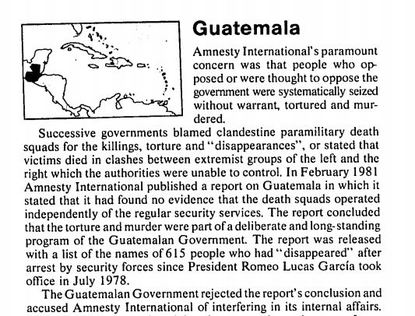
Amnesty International Annual Report 1982; Source: Amnesty International, 1982
|
"My brother was tortured for sixteen more days. They cut off his fingernails, they cut off his fingers, they cut off his skin, they burned parts of his skin. Many of the wounds, the first ones, swelled and were infected. He stayed alive. They shaved his head, left just the skin, and also they cut the skin off his head and pulled it down on either side and cut off the fleshy part of his face. My brother suffered tortures on every part of his body, but they took care not to damage the arteries or veins so that he would survive the tortures and not die." Below: Fire at Spanish Embassy and the death of Menchú's father
Source: When the Mountains Tremble, 1983 |
"Menchú's childhood experiences had a huge impact on her desire to make a difference for her people. She saw the unfairness they suffered, both in terms of how they were chased off their land in the altiplanos and how terribly they were treated at work on the fincas. When government got more dangerous, jailing and killing anyone who disagreed with their views on land distribution, including Menchú's family members, that only increased her desire to work for change." |
In her "desire to work for change", Menchú became an outspoken leader in the CUC (Peasants' Unity Committee), making her a military target. Fearing for her life, she fled to Mexico in 1980. |