
Controversy
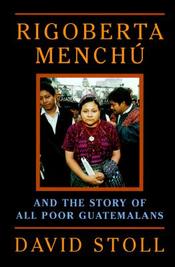
David Stoll's book, Rigoberta Menchú and the Story of All Poor Guatemalans; Source: BetterWorldBooks
|
After Menchú received the Nobel, American anthropologist David Stoll published an attack on the validity of her testimonio I, Rigoberta Menchú [see "Breaking the Silence"]. After closely examining her every statement in the book and conducting years of meticulous research on her early life, he found several discrepancies.
The largest included misrepresentation of her education and her presence at her brother's murder. These discrepancies subsequently mushroomed into a colossal scandal smearing Menchú's name. However, there have been copious amounts of research defending Menchú's testimonio and standpoint.
|
"Testimonio is a performance-based, collaborative form of writing, grounded not in journalism or legal testimony but in anthropology. Testimonio is not legal testimony...nor a collection of verifiable facts, as Stoll insists. Indeed, Stoll's exposé of Menchú fails precisely because of this insistence." |
"But, of course, the testimonio is not legal testimony at all. Is it more like autobiography? Impartiality is never asked or expected of autobiographers. Who would fault Frederick Douglass for lacking a more balanced attitude toward slavery, or Winston Churchill toward Nazism? Nor is selectiveness considered deviant..." |
|
Rigoberta Menchú, interview with Juan Jesús Aznárez; Source: The Rigoberta Menchú Controversy
|
Multiple fallacies also exist within Stoll's research. For instance, he claimed to have consulted "archival research" thoroughly. The veracity of this statement, however, may be challenged: as Dante Liano indicates, "Which archives, it is hard to know. Are there actual files on the war in Guatemala? If there are and they were opened for an American, it might be useful to ask why the army has denied access to them to the Commission for Historical Clarification..." Furthermore, Stoll's work is rather selective, drawing from a pool of 120 interviews, but utilizing only those that supported his viewpoint. Critics also point out "frequent incongruencies between the author's conclusions and the facts cited to support them", and the skewed "ethical scale of his argument." (Pratt, The Rigoberta Menchú Controversy)
|
To say that she lied means no genocide every occurred in Guatemala, troops never went into villages, gathering women in schools and men in churches, and then systematically killing them to 'raze the land' around the guerrillas. To say that she lied means that no social injustice ever took place in Guatemala...To say that she lied is taken to mean that everybody lied: the church, Amnesty International, the UN, various human rights commissions. It means that it was all a mistake by the usual suspects designed to stain the good name of that marvelous tourist paradise 'Guatemala' in which peace and order shall always reign."
-Dante Liano, in The Rigoberta Menchú Controversy